If you’ve spent any time researching skincare, you’ve probably come across conflicting advice: some sources say never combine vitamin C and retinol, while others insist it’s perfectly fine. So which is it? The honest answer is more nuanced than a flat yes or no — and understanding why will help you build a routine that actually works for your skin.
This guide breaks down whether you can use vitamin C and retinol together, the science behind why they’re often kept apart, and the safest way to include both in your routine without triggering irritation.
Why People Say Not to Mix Them
Vitamin C (specifically L-ascorbic acid, the most researched form) works best in a low-pH, acidic environment. Retinol, on the other hand, is most effective and stable at a more neutral pH. When layered directly on top of each other, they can theoretically destabilize one another, reducing the effectiveness of both.
There’s also a practical concern: both ingredients can be independently irritating, especially for those newer to actives. Vitamin C can cause mild tingling or redness in sensitive skin, and retinol is well known for causing dryness, flaking, and sensitivity — especially in the first several weeks of use. Combining them in a single application increases the odds of irritation, redness, or a compromised skin barrier.
What Dermatologists Actually Recommend
Despite the theoretical pH conflict, most dermatologists agree the bigger practical concern is irritation, not chemical instability. Their most common recommendation isn’t “never combine them” — it’s separate them by time of day.
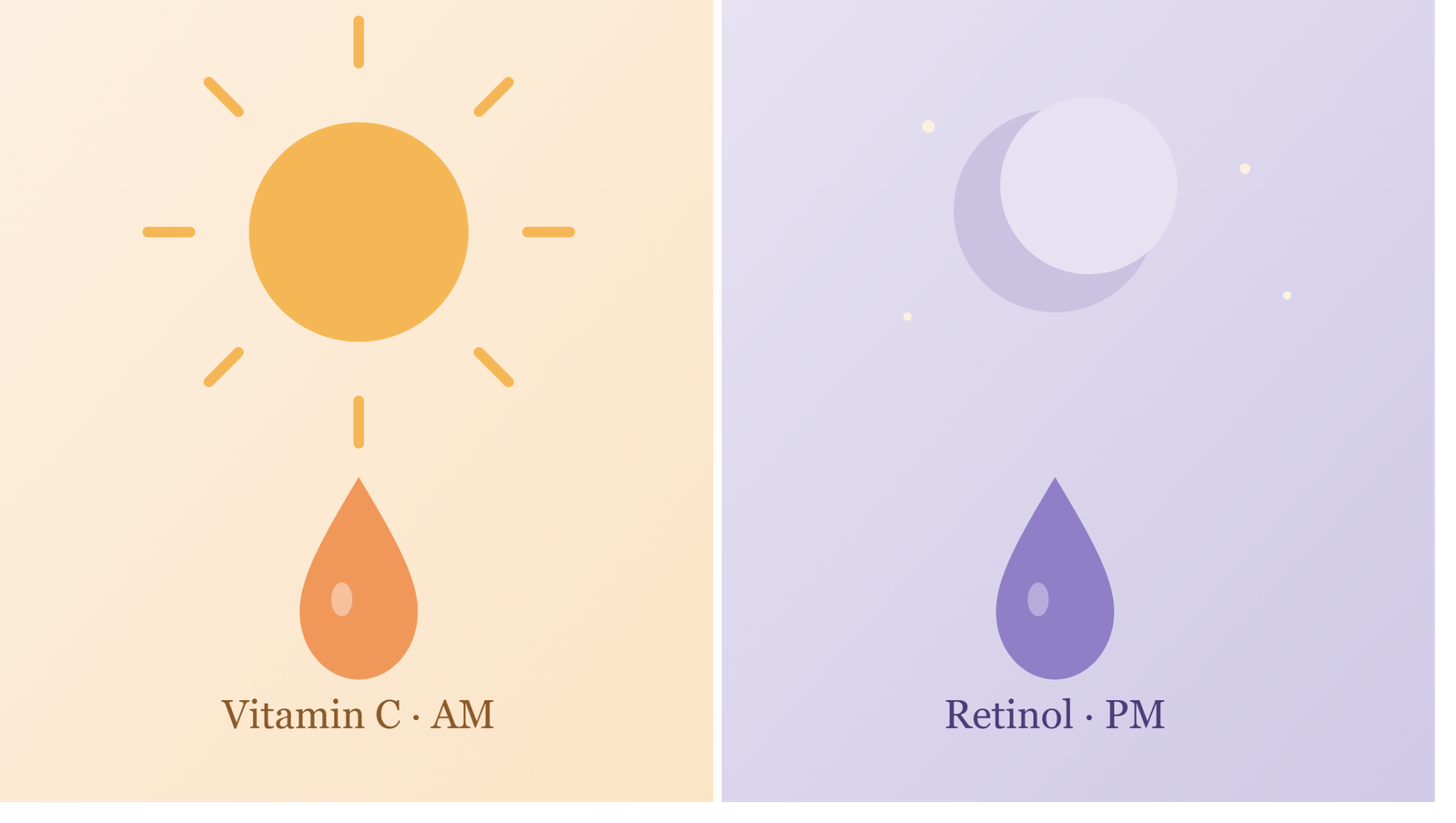
The AM/PM Split (Most Recommended Approach)
- Morning: Vitamin C — Apply after cleansing and before moisturizer and SPF. Vitamin C works well in the morning because it provides antioxidant protection against environmental damage (UV exposure, pollution) throughout the day.
- Night: Retinol — Apply retinol as part of your evening routine, after cleansing and before moisturizer. Retinol increases sun sensitivity, so nighttime use is standard practice regardless of whether vitamin C is involved.
This approach lets you use the best order to apply skincare products for both ingredients without asking your skin to process two potent actives back to back.
Can You Use Them in the Same Routine, Just Spaced Out?
If you strongly prefer using both vitamin C and retinol in the same routine (for example, if mornings are the only time you remember skincare), it’s not necessarily off-limits — but dermatologists generally suggest:
- Apply vitamin C serum first and let it fully absorb (5–10 minutes)
- Follow with a hydrating layer, such as a lightweight moisturizer
- Introduce retinol gradually, starting 2–3 nights per week regardless of when vitamin C is used, to monitor how your skin responds
Even with spacing, most dermatologists still lean toward the AM/PM split as the lowest-irritation, most sustainable long-term approach — particularly for anyone with sensitive or reactive skin.
Signs You’re Combining Them Incorrectly
If you’re experimenting with using both in close proximity, watch for:
- Increased redness or flushing beyond your normal baseline
- Stinging or burning sensation that lingers rather than fades
- Excessive dryness or flaking not typical of your skin
- Breakouts appearing in areas you don’t normally break out
Any of these signs suggest it’s time to fall back to the AM/PM split rather than continuing to layer them together.
How to Introduce Both Without Overwhelming Your Skin
If you’re new to either ingredient, don’t introduce them at the same time. A safer approach:
- Start with one ingredient first (commonly vitamin C, since it’s generally better tolerated)
- Give your skin 2–3 weeks to adjust before introducing the second
- Begin retinol at a low frequency — 2 nights per week, gradually increasing as tolerated
- Always follow with a barrier-supporting moisturizer containing ceramides or hyaluronic acid, especially while your skin adjusts
Frequently Asked Questions
Is it bad to use vitamin C and retinol on the same day? Not necessarily. Using vitamin C in the morning and retinol at night is the standard, dermatologist-recommended approach and is considered safe for most skin types.
Will vitamin C and retinol cancel each other out if used together? The pH conflict is largely theoretical for most formulations sold today, since many brands stabilize their products to reduce this issue. The bigger real-world concern is irritation, not effectiveness loss.
What should I use if I can only pick one? For most people, retinol has stronger long-term evidence for anti-aging and cell turnover benefits, while vitamin C is better suited for daytime antioxidant protection. Many dermatologists recommend starting with whichever addresses your primary concern first.
Final Thoughts
You don’t have to choose between vitamin C and retinol — but you do need a smart approach to using them. Following the AM/PM split lets you get the full benefit of both ingredients — antioxidant protection during the day, cell renewal at night — without unnecessarily stressing your skin barrier.
Disclaimer: This article is for informational purposes only and is not a substitute for professional dermatological advice. Consult a dermatologist before introducing new active ingredients, especially if you have sensitive or reactive skin.